Victoria Bandurovskaya ★★★★★
"This is my favorite freedive school in Amed. I found in “Bali Freedivers Amed” everything I was looking for: professional free dive lessons, theory and practice…"
2 months ago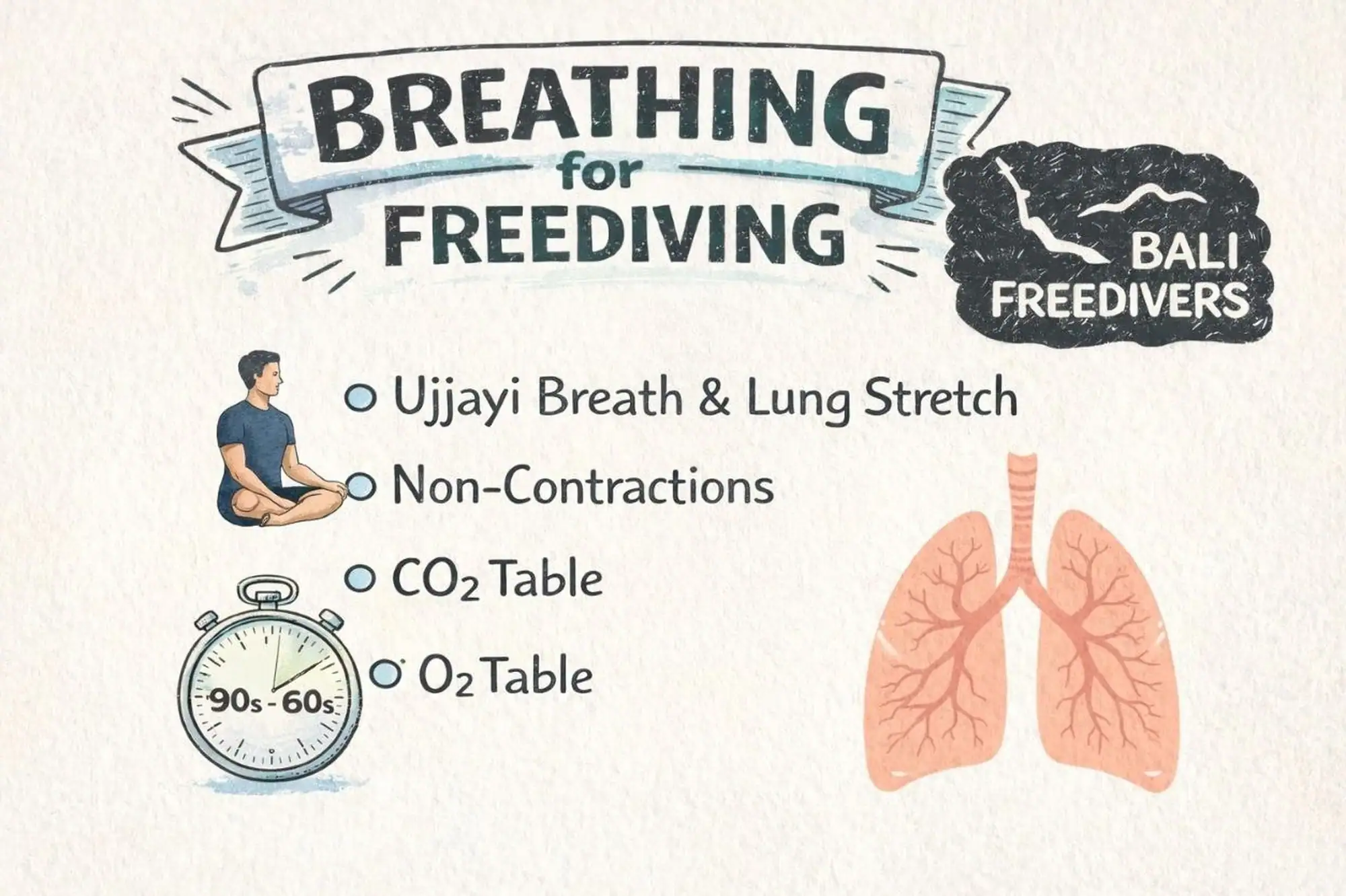
Drills and progressions used at Bali Freedivers to build static and dynamic breath-hold safely. For freedivers past Level 1.
Published: 2026-04-02 | Updated: 2026-04-02
Advanced Freedivers Breathing For Freediving Breathwork Freediving Training Pranayama
This breathing preparation guide is intended for dry training only. The exercises should be performed on dry land and not in water. Some of the exercises may cause dizziness. Therefore, it is recommended to perform the exercises in a seated position on a soft surface in a safe environment.
A powerful and effective inhale is the basis for every dive, enabling the diver to store the maximum amount of oxygen prior to descent. This requires the diver to have the power and flexibility in the diaphragm and the rib cage. Breathing also helps to relax the diver and avoid unnecessary exertion in the process.
Training Structure
a) Ujjayi Breath
b) Full Lungs Stretch
CO2 tolerance is how comfortable you are during breath-holds, especially when you feel the urge to breathe. Most discomfort during early training results from increasing CO2 levels and not oxygen depletion. Increasing CO2 tolerance enables you to hold your breath for longer periods in a calm and controlled manner.
Training Structure
a)Static CO₂ Tables
Protocol:
b)Active CO₂ Tables
Non-contraction training helps in the development of the capacity to be in a state of relaxation in the early and middle phases of the breath-hold. This improves mental efficiency and the capacity to recognize inner sensations.
Training Structure
Non-Contraction Holds (5 steps):
O2 tolerance training aims to condition the body to function with less oxygen. This will be necessary for deeper dives and longer bottom times. O2 tolerance training conditions the body to function in a hypoxic state. While CO2 training conditions the body to function in a state where there is more carbon dioxide than usual, O2 tolerance training conditions the body to function in a state where there is less oxygen than usual.
O2 tables are advanced freediver tables, as they bring you closer to hypoxia, increasing the risk of blackout if not controlled. CO2 tolerance should be mastered first for beginners, as initial breath-holding difficulties tend to be CO2-related, not O2-related. CO2 tolerance should be mastered first, then O2 tables can be introduced.
Training Structure
O₂ Tables (5 steps):
5.0 ★★★★★ · 110+ five-star reviews on Google
"This is my favorite freedive school in Amed. I found in “Bali Freedivers Amed” everything I was looking for: professional free dive lessons, theory and practice…"
2 months ago"It was a truly excellent fun dive. Jan has a deep understanding not only of the dive sites but also of Indonesian culture, which made the experience even more e…"
4 months ago"I spent a month with Yan for my first course without any prior diving experience. I am very impressed with how patient and calm he is and I felt very comfortabl…"
5 months ago"I had my first ever freediving experience here - amazing! I really appreciated instructor Jan's approach to the body of being met where I was at instead of push…"
2 months ago"The Freedivers is a place for people curious about the free diving with skilled instructor to guide through this liberating activity. I thank Yan for the suppor…"
2 months agoAI assistant. For bookings, message us on WhatsApp.